
Mehmet Emin Buğra, a pioneering figure of the East Turkistan cause, was commemorated on the 60th anniversary of his passing at the International Mehmet Emin Buğra Symposium in Istanbul, where his struggle, ideas, and spiritual legacy were discussed.
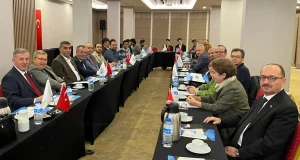
One of the emblematic figures of the East Turkistan independence movement—statesman, scholar, poet, and thinker Mehmet Emin Buğra—was commemorated through an international symposium hosted by Istanbul Sabahattin Zaim University on the 60th anniversary of his death. Organized through the cooperation of the Silk Road Civilizations Application and Research Center of Istanbul Sabahattin Zaim University, the Yunus Emre Institute, the Farabi Education and Culture Association, Buğra Academy, the East Turkistan Scholars Association, the Digital Memory Association, and Taklamakan Publishing, the International Mehmet Emin Buğra Symposium was held at the Abdullah Tivnikli Conference Hall.
The symposium was attended by Istanbul Deputy Governor Yücel Gemici, Rector of Istanbul Sabahattin Zaim University Prof. Dr. Ahmet Cevat Acar, Vice Rector Prof. Dr. Nihat Erdoğmuş, presidents and representatives of civil society organizations, academics, students, and many individuals devoted to the East Turkistan cause.
ACAR: THE TURKIC WORLD HAS LOST ITS DIRECTION
In his opening remarks at the symposium, Rector Prof. Dr. Ahmet Cevat Acar stated that following the dissolution of the Ottoman Empire and the abolition of the caliphate, the Turkic world had, in many respects, lost its sense of direction. Referring to Mehmet Emin Buğra—founder and first President of the East Turkistan Islamic Republic established in 1933—as a figure who waged an exemplary struggle, Acar said:
“When a civilization loses its own concepts, its way of thinking also changes direction. This is exactly the situation experienced by the Turkic world, which is spread across a vast geography. We must rediscover our own values and concepts and strengthen our unity by embracing our differences as a source of richness. If we can achieve this, I believe that East Turkistan will attain its freedom in the near future.”
BOLAT: POSITIVE DEVELOPMENTS ARE TAKING PLACE IN THE TURKIC WORLD
Dr. Mehmet Ali Bolat, Director of the Silk Road Civilizations Application and Research Center, expressed his satisfaction with Istanbul Sabahattin Zaim University hosting such a meaningful symposium. Bolat noted:
“In recent years, positive developments have been taking place across the Turkic world. The Organization of Turkic States was established in 2021. I hope that these steps will also bring favorable outcomes for East Turkistan.”
A STATESMAN COMPARABLE TO ALIJA
Abdullah Karakaş, President of the Farabi Education and Culture Association, stated that Mehmet Emin Buğra—poet, veteran, mujahid, and leader of the East Turkistan nation—could be compared to Alija Izetbegović in terms of his role as an intellectual leader. Karakaş emphasized that through the association they founded, they have been carrying out activities in international arenas for the East Turkistan cause entrusted to them by their mentors. He stated:
“We are striving to fulfill our teachers’ advice: ‘Let at least a few of our students who go abroad work on the materials we need.’ For the time being, we are unable to send our work back to the homeland.”
Karakaş added that he hopes such efforts will yield promising results in the future.
ALİOĞLU: HIS CONCERN WAS THE NATION, HIS CAUSE WAS FREEDOM
Muhammed Ali Alioğlu, President of the Buğra Academy Center, stated that their efforts to bring Mehmet Emin Buğra back into public focus were not motivated by family ties. Alioğlu said:
“Mehmet Emin Buğra is the emblematic figure of a nation’s, a country’s, and an entire geography’s struggle for freedom. His concern was the nation, and his cause was freedom. He was fully aware that without freedom, neither a nation nor religion can survive.”
“IF TRUTH IS NOT ORGANIZED, FALSEHOOD WILL DEFEAT IT”
Âlim Can Buğdan, President of the East Turkistan Scholars Association, emphasized that Mehmet Emin Buğra was a scholar who undertook great and significant struggles for the freedom of East Turkistan. Hamdi Arslan, a faculty member at the Faculty of Islamic Sciences at Fatih Sultan Mehmet Vakıf University, stated that the East Turkistan issue—of which he had been aware from an early age—remains one of the most pressing problems of the Islamic world. Arslan noted:
“There is a saying by Mustafa Sabri Efendi: ‘If truth is not organized, falsehood will organize itself and defeat it.’ Those involved in the Turkistan cause must understand this principle very well.”
Arslan also expressed his belief that efforts carried out with merit and discipline in line with this principle would inevitably yield results.
HARB: WE INTRODUCED EAST TURKISTAN TO THE ARAB WORLD
Prof. Dr. Muhammed Harb, a faculty member at the Faculty of Islamic Sciences at Istanbul Sabahattin Zaim University, stated that he considers himself to be East Turkistani and shared memories from the period when he served as an assistant to Isa Yusuf Alptekin. Harb said:
“The Arab world was not aware of the East Turkistan cause. We brought this issue to the agenda of the Organization of Islamic Cooperation. Since then, East Turkistan has had a platform and representation within the organization.”
He added that he takes pride in the work he has carried out for the struggle of East Turkistan.

Following the opening program, the symposium continued with four thematic sessions.
The first session was chaired by Assoc. Prof. Dr. Harun Tunçer. Under the title “Mehmet Emin Buğra’s Years of Struggle in East Turkistan,” Hamit Göktürk, Dr. Atilla Elwıshy, Dr. Higashitotsu Kutluk, Dr. Esed Süleyman, and PhD student Sabina Mashurova participated as speakers.
The second session, titled “Mehmet Emin Buğra’s International Struggles,” was chaired by Dr. Abdurrahim Devlet. The session featured presentations by Assoc. Prof. Dr. Tekin Tuncer, Prof. Dr. Erkin Emet, PhD student Muhammed Emin Uygur, Abdushukur Qumtur, and Dr. Nabijan Tursun.
In the third session, presentations were delivered under the theme “Mehmet Emin Buğra’s Intellectual World.” Chaired by Assist. Prof. Dr. Ali Demirel, the session included presentations by Muyesser Eminhacı, İbrahim Kaşgar, and PhD students Elif Altun, Hamiyet Özer, and Yusuf Ulusoy.
The fourth and final session, titled “The Traces and Spiritual Legacy of Mehmet Emin Buğra,” was moderated by Dr. Abdullah Tırabzon. During the session, Dr. Tasneem M. Harb, Prof. Dr. Ahmet Abdulkadir Şazeli, Dr. Ahmet Cemal, and Dr. Doğan Şengül addressed the participants.
A Scholarly Tribute Concluded with a Certificate Ceremony
The symposium, which attracted strong interest from academics, researchers, and students, concluded with a certificate ceremony. The program was recorded as a significant scholarly tribute aimed at preserving Mehmet Emin Buğra’s place in the struggle for East Turkistan within historical memory.


Be First to Comment