
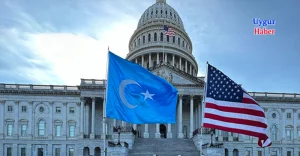
A symposium titled “Uyghur Genocide Resistance” was held at the United States Capitol. The event addressed China’s genocide policies against Uyghurs, the system of forced labor, and practices of cultural destruction.
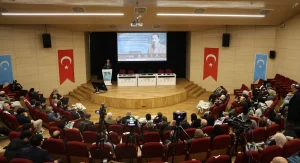
On December 10, 2025, a comprehensive symposium of landmark significance for the East Turkistan cause was held at the United States Capitol. Organized by the Uyghur Academy and the Uyghur Movement, and carried out in cooperation with more than twenty Uyghur, Tibetan, and American organizations—including the World Uyghur Congress, the Uyghur American Association, the Uyghur Human Rights Project, and the Uyghur Research Institute—the scientific summit titled “Uyghur Genocide Resistance” was recorded as a global response to China’s systematic repression and persecution of the Uyghur people.
The opening address of the conference was delivered by Dr. Rishat Abbas, President of the Uyghur Academy, a scientist working in pharmaceutical research, and Senior Advisor to the World Uyghur Congress. In his speech, Dr. Abbas emphasized that the gathering of twenty Uyghur, Tibetan, and American organizations from different parts of the world was a clear indication that the suffering endured by Uyghurs under repression by the Chinese Communist Party is now recognized as a global issue. Thanking the United States Congress for Uyghur-related legislation passed in 2020 and 2021, Abbas stressed that the Uyghur Genocide Accountability and Sanctions Act and the Uyghur Policy Act must be enacted without delay. He also expressed his gratitude for U.S. Secretary of State Marco Rubio’s statements defending Uyghurs forcibly deported from Thailand to China and for his firm stance against China’s crimes against humanity.
During the opening session, U.S. Representative Chris Smith strongly condemned the Chinese Communist Party’s grave human rights violations, including internment camps, the destruction of mosques, and forced sterilization practices. Stating that communism is a failed ideology incompatible with human dignity, Smith emphasized that halting the operations of companies involved in forced labor and slave labor systems is a moral obligation. U.S. Representative Joe Wilson, referring to his father’s struggle during World War II, expressed his belief that just as Ronald Reagan and Margaret Thatcher pushed back communism, the Uyghur people would one day defeat Chinese communism as well.
In the continuation of the opening session, Kimberly Shearer of the International Republican Institute praised the diplomatic achievements of the Uyghur diaspora and stated that material and moral support would continue. Dr. Eric Patterson of the Victims of Communism Memorial Foundation emphasized that oppression has always been defeated throughout history and that truth ultimately prevails. Luke de Pulford of the Inter-Parliamentary Alliance on China stated that leaked materials such as the Xinjiang Papers provide sufficient evidence to hold China accountable internationally and that democratic countries must urgently act together. Tencho Gyatso of the International Campaign for Tibet noted that the Tibetan people stand shoulder to shoulder with Uyghurs and that a joint struggle for freedom is essential. Dr. Scott Worden of Yale University warned that China is using artificial intelligence and facial recognition technologies as tools of genocide and called for an immediate ban on Western companies investing in Chinese technology firms.
The first session focused on economic and legal measures and was chaired by Dr. Alim Seitoff. Scott Flipse of the Congressional-Executive Commission on China Office stated that academic and scientific reports are among the most effective tools for dismantling China’s genocide-linked supply chains. Rushan Abbas, Executive Director of the Uyghur Movement, stressed the need for a strong diplomatic counteroffensive, particularly in the Islamic world, against China’s propaganda claims that “Uyghurs are happy.” William Nee of the National Endowment for Democracy warned that China’s export of its police-state model to authoritarian regimes poses a serious global threat. Omer Kanat, President of the Uyghur Human Rights Project, stated that published reports are increasingly cornering perpetrators through legal means. Rizwana Ilham of the Swiss Uyghur Association shared concrete achievements in Switzerland and European Union countries aimed at stopping the import of goods produced through forced labor.
The second session addressed religious repression and transnational intimidation policies and was moderated by Adam King. Dolkun Isa, President of the World Uyghur Congress, emphasized that firsthand testimonies are key to exposing China’s crimes and that African and Muslim countries in particular must be informed of these realities. Abdulhakim Idris, President of the Uyghur Research Center, highlighted the importance of strengthening relations with Turkey and the Islamic world to counter China’s disinformation activities within the diaspora. Ryan Fiorese of the International Campaign for Tibet criticized China’s attempts to infiltrate religious leadership processes and institutions. Sarah Makin stated that China’s repression of Christian communities has become a global religious threat extending as far as the Vatican. Dean Baxendale exposed China’s cultural piracy through the production of counterfeit editions of books written by Uyghur activists.
The third session focused on the preservation of Uyghur identity and culture and was chaired by Professor Rebecca Clothey. Dr. Nurnisa Kurban of the Uyghur Academy spoke about the importance of five volumes of Uyghur mother-tongue textbooks prepared by more than one hundred intellectuals for cultural continuity. Kevser Kamil discussed the challenges of instilling identity among children growing up in the diaspora and shared possible solutions. Misran Dolan of the Uyghur American Association presented community organizing and migrant support efforts carried out in the U.S. state of Virginia. Abdulhamit Karahan of the Uyghur Academy Foundation emphasized the role of academic work conducted since 2009 in establishing February 21 International Mother Language Day and May 5 Doppa Festival as significant cultural observances within the diaspora. Irade Kashgari of the Mihriban Ana Uyghur School stressed that educational institutions and national consciousness are indispensable for the survival of a nation.
In the fourth and final session, chaired by Memet Tohti, the 40th anniversary of the Urumqi student movement of December 12, 1985, was discussed. Dolkun Isa stated that this movement was the first democratic mass uprising of Uyghur youth in their homeland and that, as someone who personally witnessed it, he considers it a cornerstone of the modern independence struggle. Rushan Abbas emphasized that the 1985 protests preceded the Tiananmen Square and Eastern European democratic movements and profoundly shook China’s colonial policies. Turdi Ghoja, Chief Advisor to the Uyghur Movement, noted that the Urumqi student movement laid inspirational groundwork for the 1989 Tiananmen student protests and marked a historic turning point. Ilshat Hasan Kokbore, Director of China Studies at the Uyghur Academy, stated that even 40 years later they continue to fight for the same goals and that the national enthusiasm sparked by hearing about the protests through Voice of America remains alive today. Dr. Faizullah Zaidun of the Uyghur Academy explained that after the 1985 movement, many students like himself combined their academic careers with national awakening to reach their current positions.
At the conclusion of the program, Rushan Abbas, Executive Director of the Uyghur Movement and Executive Chair of the World Uyghur Congress, delivered the closing remarks. She thanked American politicians, researchers, and civil society representatives who participated in the symposium and consistently supported the Uyghur people, as well as the 7 American and Tibetan organizations and 13 Uyghur organizations that contributed to the successful organization of the event. Abbas emphasized that this movement in the United States would play a concrete and positive role in stopping China’s genocide against Uyghurs, ending forced labor practices, securing the release of imprisoned Uyghur intellectuals, shutting down internment camps, halting transnational repression against Uyghurs, and preserving the Uyghur language and identity. Stressing that the Uyghur people must never lose hope, she stated that the struggle against China would continue together with democratic countries, for justice and freedom, even if only a single Uyghur remains.
The program concluded with participants visiting a rich art exhibition by Uyghur artists and enjoying traditional Uyghur cuisine.



Be First to Comment