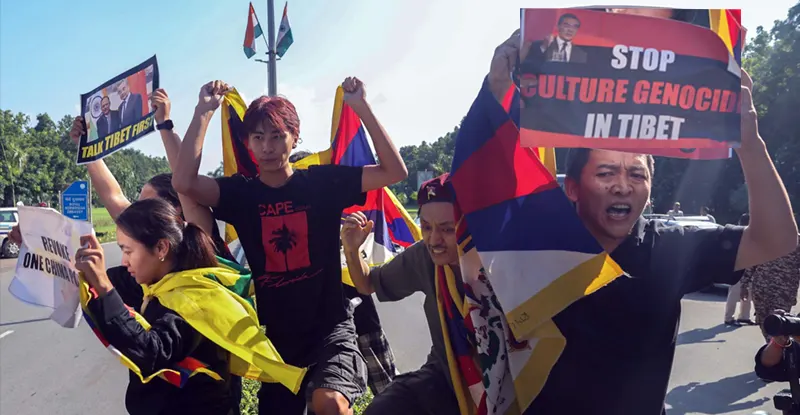
Chinese Foreign Minister Wang Yi’s visit to India failed to ease tensions. Talks made limited progress, while a protest by Tibetan youths drew significant attention.
Wang Yi visited India on August 18 and 19, 2025, during which he met with Indian Foreign Minister S. Jaishankar, National Security Adviser Ajit Doval, and Prime Minister Narendra Modi in New Delhi.
During the visit, protests also emerged. Members of the Tibetan Youth Congress gathered near Hyderabad House in New Delhi on August 19 to demonstrate against Wang Yi’s presence in India. The demonstrators condemned China’s repressive policies, particularly targeting Tibetans and Uyghurs, and urged the Indian government to take a firmer and clearer stance against Beijing’s actions.
— Uygur Haber (@UygurHaber) August 20, 2025
Although Wang Yi’s two-day talks were perceived as an effort to ease the strained relations between the two countries, no concrete progress was achieved in resolving critical issues. The discussions focused on the border conflict that has persisted since 2020, ongoing trade barriers, and regional security concerns.
Despite these discussions, the meetings only resulted in the creation of new working groups and commitments to engage in “further dialogue” in the future. A substantial solution to the long-standing border dispute remained unattainable. Wang Yi returned to Beijing on the evening of August 19, with his visit overshadowed by the lack of tangible results and the public protests.
Senior Uyghur activist and founding president of the Ilham Tohti Initiative, Enver Can, commented on the Tibetan youths’ protest, stating: “We, the Ilham Tohti Initiative, support and join the Tibetan youths’ protest action. We have, for years, been protesting Wang Yi’s presence at the Munich Security Conference (MSC). We are sure that Uyghur youth around the world would join us in supporting Tibetan youths’ demonstrations.”





Be First to Comment