
At a Berlin event marking the 1959 Tibetan Uprising, Uyghur activist Enver Can stressed the shared fate and historical ties of Uyghurs and Tibetans and urged stronger joint efforts for freedom.
March 10 is commemorated worldwide as the anniversary of the 1959 Tibetan Uprising, when Tibetans rose up against Chinese rule. Each year, remembrance events are held across different countries to highlight the Tibetan people’s call for freedom and ongoing human rights concerns.
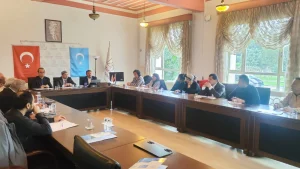
This year, an event held in Berlin, Germany, brought together activists and supporters to mark the anniversary and express solidarity with the Tibetan people. Among the speakers was Enver Can, who attended the gathering as the founding president of Ilham Tohti Initiative e.V. and delivered a speech addressing the shared struggles of Tibetans and Uyghurs.

“A day deeply rooted in the hearts of Tibetans”
In his remarks, Enver Can emphasized the symbolic importance of March 10 for the Tibetan people.
“Today we gather here to commemorate this great day, which holds a special place in the heart of every Tibetan,” he said. “It marks the moment when brave Tibetan women and men rose up against China’s occupation and raised their voices for freedom.”
He noted that gatherings held around the world not only demonstrate solidarity with Tibetans but also encourage other peoples facing repression by the Chinese government to unite and strengthen their collective voice.
Shared struggles under Chinese rule
Can stressed that Tibetans, Uyghurs, and Southern Mongolians today face similar forms of political repression and cultural pressure. According to him, policies such as political persecution, cultural assimilation, and racial discrimination have become increasingly severe.
He also referred to practices widely criticized by human rights organizations, including forced population transfers, birth control policies, sterilization, and pressure to abandon language, religion, and cultural identity.
“These policies threaten the survival of our peoples,” Can stated, adding that a growing number of democratic countries and civil society organizations have recognized such practices as genocide and crimes against humanity.
Historical ties between Uyghurs and Tibetans
In his speech, Can also highlighted the long historical relationship between Uyghurs and Tibetans. He noted that the two peoples maintained close political and cultural ties throughout history and played an important role in shaping Central Asian civilization.

He recalled that leaders of the East Turkistan movement, Isa Yusuf Alptekin and Muhammad Emin Bughra, met with the Tibetan spiritual leader 14th Dalai Lama on April 14, 1960, in Mussoorie, India. That meeting, he said, laid the groundwork for modern cooperation between the two movements.
Further cooperation followed in the diaspora, including the establishment of the “Allied Committee of Uyghur, Tibetan and Southern Mongolian Peoples” in 1985 in Zürich.
Cooperation in exile movements
Can also referred to the creation of the Unrepresented Nations and Peoples Organization (UNPO) in 1991, noting that Erkin Alptekin and Tibetan diplomat Lodi Gyari played key roles in its founding.
According to Can, these initiatives helped build cooperation among Uyghur, Tibetan, and Southern Mongolian communities in the diaspora, particularly in the United States and across Europe.
Call for deeper cooperation
While acknowledging the efforts of earlier generations, Can said the current level of cooperation among the three peoples could be further strengthened.
“It is not enough for us to meet at conferences, participate in demonstrations, or sign joint petitions,” he said. “There is much more potential for deeper political and strategic cooperation.”
Addressing younger generations of Uyghurs and Tibetans, he encouraged them to build closer ties and expand collaboration.
Congratulations to Tibetan leadership
Concluding his remarks, Can congratulated Penpa Tsering on his re-election as Sikyong, the political leader of the Tibetan government-in-exile.

He also called on the World Uyghur Congress and the Tibetan leadership to take new initiatives to deepen cooperation between their movements in the context of a changing global geopolitical landscape.
“Uyghurs and Tibetans will continue to stand side by side as friends,” Can said. “Our destinies are closely connected, and together we can be stronger in the struggle for the freedom of our peoples.”





Be First to Comment