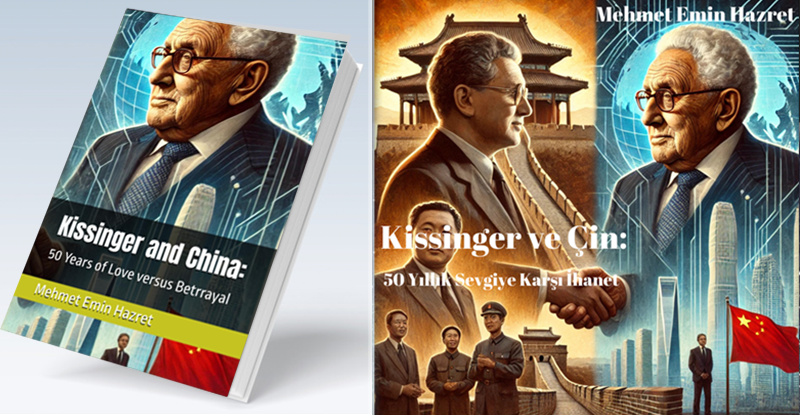
Mehmet Emin Hazret’s book, Kissinger and China: 50 Years of Love versus Betrayal, was published. The work analyzes Henry Kissinger’s half-century relationship with China, offering a critical perspective on U.S.-China relations.
Uyghur writer, and screenwriter Mehmet Emin Hazret’s new book, “Kissinger and China – 50 Years of Love versus Betrrayal,” was recently published in both English and Turkish. The work examines the anatomy of Henry Kissinger’s half-century relationship with China, offering a critical perspective for understanding the modern history of U.S.-China relations.
Kissinger and China: 50 Years of Love vs. Betrayal examines the pivotal role of Henry Kissinger in shaping modern U.S.-China relations. His diplomatic outreach in 1971 marked a crucial step in normalizing ties between the two nations, but its long-term consequences far exceeded expectations. With Western financial and technological support, China rose to power—not as a democracy, as some had hoped, but as an authoritarian superpower challenging Western dominance.
The book explores Kissinger’s 50-year relationship with China, analyzing its ethical and strategic dimensions. While he played a key role in integrating China into the modern world and facilitating Western capital and technology flow, this process exposed contradictions within the West’s stance on human rights, democracy, and ethical values. His silence on China’s authoritarian policies—especially human rights abuses against the Uyghurs—has sparked significant debate.
Kissinger’s engagement with China was not an unqualified diplomatic success. The economic and technological assistance provided by the U.S. accelerated China’s rise while leading to a neglect of domestic infrastructure and industry. As China developed high-speed rail networks, modern cities, and cutting-edge technology, the U.S. fell behind in crucial infrastructure investments, highlighting the unintended consequences of Kissinger’s strategy.
By questioning Kissinger’s ties with China, his diplomatic maneuvers, and their global ramifications, the book reveals how economic and political cooperation between the U.S. and China led to the sidelining of fundamental Western values like freedom and human rights. His balancing act between admiration for China and Western strategic interests ultimately resulted in what many perceive as a betrayal.
Kissinger and China: 50 Years of Love vs. Betrayal provides an in-depth analysis of U.S.-China relations, dissecting Kissinger’s legacy and the West’s role in China’s economic and military ascent. The book offers critical lessons for global politics and diplomacy, shedding light on the far-reaching consequences of these historical decisions.






Be First to Comment