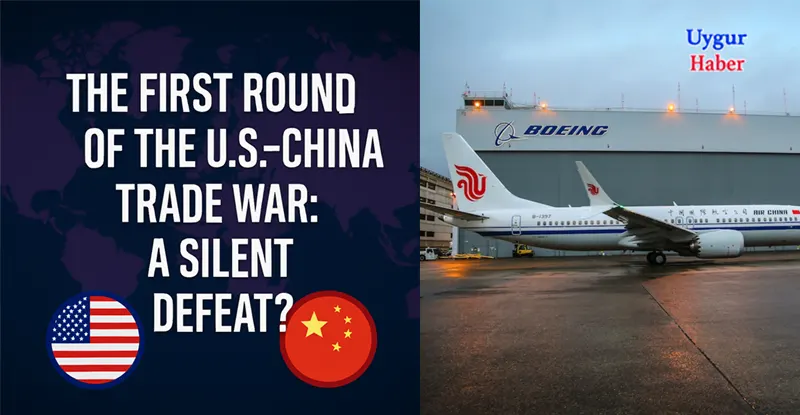
“If this trajectory continues, China may be forced to reassess and alter its broader trade war strategy. For now, however, the first round ends with a quiet yet decisive defeat for Beijing.”
Mehmet Emin Hazret
One of the most pressing economic confrontations shaping the global agenda in recent years, the U.S.-China trade war continues to reveal its impact across various fronts. In some Turkish media outlets and on social media platforms, narratives suggesting that China has emerged victorious from this economic battle are widely circulated.
Examples such as China’s cancellation of Boeing aircraft orders and the return of newly delivered planes are portrayed as strategic moves that have cornered the United States. Chinese headlines like “An unexpected outcome: China earns global respect!” or “Trump finally understood: coercion doesn’t work” further bolster this perception. However, data and international reactions tell a different story.
The Boeing Crisis: China’s Move and the Market’s Response
In mid-April 2025, the Chinese government made a bold announcement instructing its national airlines to halt all purchases of Boeing aircraft, cancel pending orders, and return recently delivered jets. As part of this directive, two Boeing 737 aircraft delivered to China on April 15 were turned away and sent back to the United States.
Initially, this caused a drop in Boeing’s stock value. The markets interpreted the move as China exerting economic pressure on the U.S., reinforcing the narrative of China’s strategic upper hand. Yet, this perception was short-lived.
Global Demand Shifts: Who Filled the Gap Left by China?
Just two days later, on April 17, Russia officially expressed interest in purchasing the Boeing 737s that China had returned. Following suit, Malaysia Airlines announced its willingness to take over all the cancelled orders. Around the same time, India declared it was open to new agreements with Boeing.
These swift responses filled the void left by China, allowing Boeing to recover its market position and stabilize its stock. This sequence of events demonstrated that China’s attempt to use economic leverage was effectively neutralized by the adaptability of global supply chains and the agility of multinational corporations.
The U.S. Strikes Back: Trade War Expands
In response to China’s aggressive stance, the U.S. administration escalated the trade conflict. On April 21, 2025, the U.S. Department of Commerce announced a 3521% tariff on solar panels and related components imported from Cambodia, Malaysia, Thailand, and Vietnam—countries closely linked to China’s production network. This tariff, one of the highest in U.S. history, aimed to block Chinese goods from entering the U.S. through indirect channels.
This move not only targeted China but also disrupted the production hubs it had built across the Asia-Pacific region. As the scope of economic sanctions expanded, China’s efforts to form regional alliances weakened.
Panic in the Pacific: Distancing from China Begins
The U.S.’s aggressive new tariff policy caused concern among China’s trade partners in the Pacific. Countries like Cambodia, Thailand, and Vietnam tightened regulations on Chinese goods passing through their ports en route to the U.S. Some even began drafting new legislation to restrict transit trade. To avoid jeopardizing their own relations with Washington, these nations started to distance themselves from Beijing, recalibrating their economic policies.
China’s Isolation: The Limits of Credit Diplomacy
China’s long-standing “credit diplomacy” strategy, which aimed to bind developing nations through infrastructure projects and low-interest loans, faced a harsh test. With the U.S. signaling both direct and indirect sanctions, many of these countries reconsidered their ties with Beijing. As the risks—both political and economic—of aligning too closely with China became clearer, several nations opted for a more cautious approach.
Conclusion: A Quiet Defeat for China
Despite triumphant rhetoric in domestic media, China’s strategic maneuvers in the first round of the trade war have not gained meaningful traction internationally. The Boeing incident revealed the limits of its economic leverage, while the U.S. moved swiftly to erect new barriers that hindered China’s global trade flow. Meanwhile, the very countries China hoped to rally against the U.S. have instead drifted away in favor of protecting their own interests.
As this round concludes, the U.S. emerges with strengthened economic authority, while China finds itself increasingly isolated. If this trajectory continues, China may be forced to reassess and alter its broader trade war strategy. For now, however, the first round ends with a quiet yet decisive defeat for Beijing.







Be First to Comment