
On July 22, 2025, the US Congress hosted a special briefing on captive nations, bringing together representatives from the East Turkistan Government in Exile (ETGE), Tibet, Southern Mongolia, US officials, and congressional staff. The event addressed the ongoing occupation, repression, and cultural erasure experienced by these regions under Chinese rule.
In a statement, the ETGE highlighted the significance of the 1959 Captive Nations Resolution (Public Law 86-90), which recognizes nations suffering under communist imperialism and calls for US support in restoring their freedom and sovereignty. East Turkistan and Tibet are specifically named in the resolution.
Salih Hudayar, East Turkistan’s Minister of Foreign Affairs and Security, delivered a powerful keynote speech. “East Turkistan was identified in the 1959 resolution as a nation oppressed by communist imperialism, not as part of China. Tragically, our captivity continues,” he stated.
Hudayar described the situation in East Turkistan as an ongoing genocide. He emphasized that millions are currently detained in camps and prisons, and over a million children have been forcibly separated from their families. Citing 2024 congressional testimony, he claimed that 25,000 to 50,000 Uyghur and Turkic youths are killed annually for organ harvesting. He also criticized Turkey for cooperating with Chinese intelligence to suppress the East Turkistan independence movement and warned of the Chinese Communist Party’s efforts to divide and assimilate Uyghur communities abroad.
He urged Congress to recognize East Turkistan as an occupied nation, hold hearings on its struggle for independence, and investigate China’s transnational repression of the Uyghur diaspora. “Removing the CCP alone isn’t enough,” Hudayar stressed. “The Chinese empire must be dismantled. Restoring East Turkistan’s liberty is a responsibility laid out in the Captive Nations Resolution.”
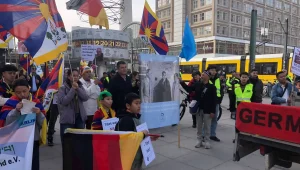
Tenzin Wangdu, representing the Tibetan-American community and the Tibetan Rangzen movement, reaffirmed Tibet’s distinct national identity. “Tibet has never been legally part of China. For more than a thousand years, we had our own government, culture, and identity,” he said. Wangdu described China’s 1951 occupation of Tibet as an invasion rather than a liberation and called for meaningful action. “Empty rhetoric is over. Only independence can ensure the Tibetan people’s survival,” he concluded.




Be First to Comment