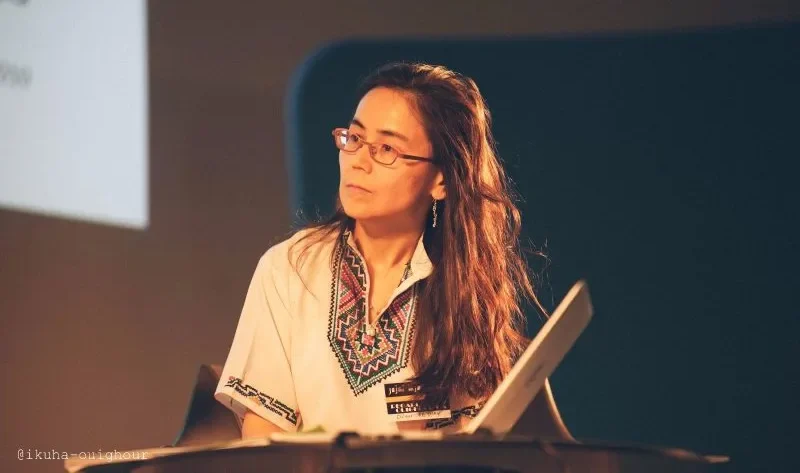
Uyghur scholar Dilnur Reyhan faces charges in France after protesting China’s abuses. Rights groups call it one of Beijing’s transnational repressions aimed at silencing critics abroad.
On October 13, a court near Paris will try Dr. Dilnur Reyhan, a prominent French-Uyghur scholar and president of the European Uyghur Institute, over charges of “degradation of property belonging to others.” The case, widely criticized by human rights groups, stems from a 2022 protest against the Chinese government — and has come to symbolize Beijing’s growing repression beyond its borders.
The complaint was filed by three employees of the Chinese Embassy in Paris, who accused Reyhan of throwing red paint on an embassy banner during a demonstration at a Paris-area music festival in September 2022. The incident, which reportedly resulted in a €25 shoe-cleaning fee, has been used to pursue legal action against her for nearly two years.
Initially, French prosecutors dismissed the case in 2023. However, it was reopened on appeal shortly after Chinese President Xi Jinping’s visit to France in May 2024, when hundreds of Uyghur, Tibetan, and other activists protested across the country. A hearing scheduled for March 2025 was postponed until October after representatives from the Chinese Embassy failed to appear.
“China Seeks to Exhaust Critics Through Legal Battles”
According to Human Rights Watch, the Chinese government’s actions represent an attempt to silence critics abroad by exploiting legal mechanisms within democratic societies. Reyhan herself argues that the case is not an isolated matter, but part of a systematic strategy of transnational repression targeting intellectuals and activists critical of Beijing’s policies in East Turkistan (Xinjiang) and beyond.
“My case is not a simple legal matter, but rather a typical example of China’s transnational repression of intellectuals and academics in the West, using democratic legal tools,” Reyhan told Uyghur News (Uygur Haber). “This is a strategy developed by China in recent years, starting in particular with Turkey, by filing a complaint against Turkish professor Erkin Ekrem, who is of Uyghur origin, and Yücel Tanay a Turkish journalist in 2020. Since then, there has been a proliferation of cases against Western academics and activists.”
She emphasized that the goal is not necessarily to win in court, but to exhaust and intimidate critics through prolonged legal battles: “The aim is to wear down these researchers and activists over years of legal proceedings — to make them lose time, energy, and money. More importantly, by taking them to court, the aim is to discourage others from criticizing the regime and to enforce a law of silence in the West on Chinese policies.”
Reyhan has been a vocal advocate for Uyghur rights and an outspoken critic of China’s systematic abuses in East Turkistan, including mass arbitrary detention, torture, family separation, cultural erasure, and forced labor — crimes that Human Rights Watch and other international bodies have said may amount to crimes against humanity.
“For the Chinese embassy, the aim is not to win or lose the case, but to impose a psychological and financial cost to silence me,” she stated during a court hearing earlier this year. “I should not be prosecuted by French courts but protected against China’s attempts to silence me.”
Reyhan Case Reflects Beijing’s Extraterritorial Repression
The case against Dilnur Reyhan mirrors a broader pattern of Beijing’s extraterritorial repression, with recent incidents targeting students, journalists, and dissidents overseas. In July, for example, Chinese authorities arrested Tara Zhang Yadi, a Chinese student studying in Paris, for “inciting separatism” after she expressed support for Tibetan rights online.
Human Rights Watch has urged French authorities to drop the charges against Reyhan, warning it only serves China’s political objectives. “People in France should be able to peacefully protest against China and other abusive governments without worrying about being prosecuted for doing so,” the organization stated.
As the October 13 hearing approaches, human rights advocates and Uyghur diaspora organizations see the trial as a test of France’s commitment to academic freedom, free expression, and resistance to foreign influence.










Be First to Comment